Saturday, December 24, 2011

Episode #1


We are starting to produce podcasts to share updates, interviews, and analysis as we prepare to fight against a new wave of budget cuts.

Professor Curry Malott from West Chester University's Education Department joins us for our first podcast interview. He is an author of many books, including Punk Rockers' Revolution: A Pedagogy of Race, Class, and Gender with Milagros Pena and A Call to Action: An Introduction to Education, Philosophy, and Native North America. He has also written many essays on education, critical pedagogy, and society.


Click here to listen!

Thursday, November 17, 2011

On the Continuation of the Occupy Movement


In the early morning of November 15, 2011 the New York Police Department raided, pepper sprayed, beat and arrested protesters at the Occupy Wall Street encampment. This raid destroyed the birthplace of what has become an international movement against the rich elite and their exploitation of the working and middle classes. Mayors of cities across the nation are following in New York City Mayor Bloomberg’s footsteps and are conducting raids at Occupy encampments across the nation. Thus ending what can be seen as the first phase of this movement.
For all of the courage we have seen in the national Occupy movement, our greatest challenges are before us. We have seen the bravery of the people that not only have created liberated spaces for the communalization of services and materials of survival, but to defend those spaces. We have seen the defense of those spaces in the general strike in Oakland, California. In New York City occupiers defended their encampment for two months from police repression. In Denver, Colorado we’ve seen the people reoccupy after riot police raided their encampment. In Portland, Oregon we’ve seen the people lock arms to stand between the police and their encampment to stop an eviction. In Chapel Hill, North Carolina we’ve seen the people stand up to S.W.A.T. Team members raid an occupied abandoned building, which was to be turned into a social center, with semi-automatic rifles. We have seen the bravery and courage of the people to stand up against the 1% and defend their liberated spaces where new possibilities of social relations can be created.
But now as the police destroy what the people have created, and winter quickly approaches, we are going to hit our roughest seas yet. We now have the great challenge to learn from the past months and use this knowledge to move this resistance as far as it can take us. We must also learn from the elders who have struggled long before we set up our tents and joined the movement. We must learn from our histories and see what can be used to further our resistance. We must learn about the student and worker uprising in Paris in 1968, when students and workers joined together to create new forms of social relationships based on mutual aid and worker’s dignity. We must learn from the Black Panther Party who struggled against the racist and colonialist American empire from within. We must learn how they built a movement for the people and by the people to create a new society outside of the capitalist mode of production. We must learn from the anarcho-syndicalists who organized and fought fascism in Spain in the 1930’s. They created new forms of production based for the people’s needs, as well as discovered new and egalitarian ways to combat the forces of oppression.
The list can go on and on of examples of our comrades who fought against the exploitation of the elite. But the important lesson here is that we are not the first people to struggle, and we are far from alone in this struggle. There is no need to reinvent the wheel, we must not only learn what made these struggles powerful, but also what made them weak. We can learn from our histories what paths not to follow and what mistakes made these movements fail.
As the current phase of our movement ends, and as we see our numbers in the camps dwindle due to police repression and the chill of the winter air, we must educate ourselves of the lessons of the past. When this movement started in mid September, no one could have imagined that it would have led to what it is now. It started as a rag-tag group of folks disenfranchised with the current social structure and with the dreams of the possibilities of a new social system. Now it is a global movement of working and middle class people from diverse backgrounds demanding an end to the alienation and exploitation of their capitalist daily lives.
We must use this lull as an opportunity to study and reorganize ourselves for when the warmth of spring returns our movement can be more fierce and powerful than before.

Monday, May 16, 2011

Update on the State Budget from WCU's President


On 5/11, a message from WCU's President, Dr. Gregory Weisenstein, gave updates on the budget:

"As a follow up to my communication to you after Governor Corbett’s announced budget proposal (March 8, 2011), during the week of May 9, 2011 State House Republicans have introduced a $27.3 billion budget plan that would restore some of the cuts to public and higher education that were proposed by Governor Tom Corbett. The Pennsylvania State System of Higher Education would receive $195 million more than the governor proposed, amounting to a 15 percent reduction from the current year’s total allocation. This is a positive development, but we also need to be reminded that the House budget is only a starting point in route to a final budget. The Senate will develop and propose their budget and give consideration to the House budget. The PASSHE Board of Governors will act upon a tuition increase at their late June meeting. These actions will play very prominently in our revenues. Thank you for your advocacy for WCU and the State System with our Harrisburg legislators. We will continue to update you with the latest budget information. Please go to the WCU homepage and click on “Budget Update” for the most up-to-date information."

(You can find the message on WCU's website by visiting this link: http://www.wcupa.edu/president/messages/ )

For more on the House Republican plan, visit http://wallaby.telicon.com/PA/library/2011/2011051074.HTM

There are several things that can be derived from this message:

1. State House Republicans' new budget plan(conveniently introduced during the week of May 9, week of graduation for all PASSHE universities) proposes a 15% reduction in public and higher education, in opposition to Corbett's proposed 54% reduction in funding. While this is indeed a reversal of 39%, this does NOT in any way fit the definition of victory for the students of Pennsylvania. Public universities tuition increases were immense and tuition rates unaffordable long before the State Legislature considered cutting already-dwindling funding. The state schools have seen drops in funding since the system was created in the early 1980s, not for a single year have the universities seen their tuition rates decrease. So, the evidence shows us that this 15% is unlikely to be retrieved in a system whose funding has been on the downturn for years. Furthermore, the newly proposed budget plan is just that- a proposal. The House may negotiate less funding than the current figures, dropping the allocations even lower by the time of the confirmed budget.

2. Accordingly, as noted by President Weisenstein, the PASSHE Board of Governors are already making plans to convene in late June to develop plans for tuition increases, whether the new proposal changes in allocations in the budget over the summer or not. What is the PASSHE Board of Governors doing to ensure affordability of tuition to all students? To whom is the Board of Governors accountable?

Saturday, April 30, 2011

Representation Without Taxation: Pennsylvania Corporations


A brief explanation of the taxation of the gas drilling companies:

http://www.pennbpc.org/gas-drillers-escape-taxes

In opposition to the argument that taxes will drive away gas companies: W. Virginia ranked #1 in new wells last year.

http://www.pennbpc.org/fact-check-west-virginia-led-nation-new-gas-wells-2010

Wednesday, March 30, 2011

CHOP from the TOP

Mark Pavlovich
Vice President of Advancement $153,045

Lawrence Dowdy
Executive Deputy to the President $153,045

Matthew Bricketto
Vice President of Student Affairs $152,753

I guess it pays not to teach any classes or come under the scrutiny of educational accountability.

Note that these figures are from 2009, so these figures have most likely gotten pay raises since then. In the meantime, WCU faculty has taken a pay freeze for the past two years.


from http://www.post-gazette.com/pg/09088/958830-85.stm

Sunday, March 13, 2011

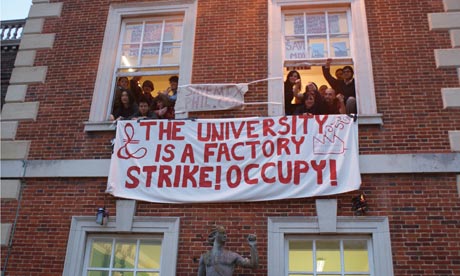
What to the State is the University Student?: In Light of the Recent Budget Cuts

As the semester closes in upon us, it becomes necessary to comment upon the current circumstances of the public university student. West Chester University, along with the other 13 state universities of Pennsylvania, have decided to raise the cost of tuition again in the coming year, even after a raise of 3.7% last year.

However, these raises do not represent the likely tuition raises that are to come. Last Tuesday, while most public university students were at home on Spring Break, newly-elected Governor Corbett unleashed a state budget proposal. His proposal includes a direct attack on our state schools and their ability to provide a quality, public education: statewide, he plans to cut the funding of our state schools by over 50%, or by $625 million dollars. Even for schools that are only state affiliated, such as nearby Temple, this means a loss of $80-90 million dollars next year. For West Chester, our paltry funding will fall by much more. Mansfield University may even close its doors.

One can see how our university has changed even within the past few years. New private dormitories that will eventually funnel our students’ funds into private hands litter the scene of what used to be a public recreational field. Plans to knock down the rest of the university-owned dorms and to build more similar privately owned dorms are in the works. The cost of student meal plans continues to increase as the quality of the factory-farmed, hormone-enhanced, genetically-modified sludge remains the same. Even the education department has been forced to let business interests sneak in by requiring students to post their clearances on a useless database called LiveText, which does little besides charge students $90.

A few months ago, on Nov. 30th, a representative from PASSHE joined the campus for a meeting that discussed ways to advocate for more funding from the state. We were encouraged to remind our representatives that 120,000 currently fill our state schools, and that 500,000 graduates of the state system live in PA- meaning that the funding of our schools is a so-called “investment” in the future of our state.

What this representative failed to realize is that this ideology is the very problem- To our State leaders, the university and its students are a mere business investment.
Who cares if the Physics Department disappears? There are not many physics students anyway and therefore it is a waste of resources- the fact that the field of Physics leads the way in scientific advancement does not matter. What does it matter if the university cannot encourage students of traditionally oppressed backgrounds to come to the university because there is no money for true financial aid packages- we can fill those spots with richer students who can afford to pay the full price in their place. What does it matter if students cannot afford the new overpriced dormitories- they can simply take out loans from private lenders with extraordinarily high interests rates to pay for it later. Our leaders have given us the message that our right to opportunity and to education does not come before their so-called right to make a profit.

Indeed, limited access to resources, information, ideas, and technology to only the members of the elite are key instruments of oppression. It is said that an ignorant populace is easily governed, that as long as people have their bread and their circuses they will not fight those who oppress them. Right now the State is attempting to dismantle a system of public education, a right that many people have shed blood for. It is time that we demand an end to business as usual.
Tuesday, February 22, 2011

On the Union Strikes in Wisconsin

Just weeks ago, Wisconsin Governor Paul Walker passed a bill that turned the State's budget surplus into $140 million in tax breaks for big businesses. Now, as events have unfolded, he has declared that the state has a major "budget shortfall"(a code word in recent years for businesses and governments wishing to pass any extreme measure that will restrict the rights of citizens under the facade of "trimming expenditures") and that public sector unions will have to pay to fill the gaps. Walker's actions are only one example among many of state and local governments giving handouts to business while pilfering from average citizens to keep treasuries balanced. As we have seen in Wisconsin, even the Democrats(who claim to be in support of the unions and claim to be working for average people) have done nothing to alleviate this obvious breach of citizens' right to collectively organize to demand better working conditions and pay rates. As governors in Ohio and Indiana announce similar plans to hamper the livelihoods of average working people in exchange of maintaining the status quo of the privileged few, eruptions of protests have served as an awakening of what the financial crisis has really meant for average citizens. This attack on the rights of working people is not acceptable, and the 70,000 citizens who came to Wisconsin's capitol last Saturday have proved that it will not be accepted as another casualty of the so-called 'fiscal crisis.' We will not pay the balance of their profiteering, cronyism, and demands for increased profits as the unprivileged give up their rights. We will not pay their unending need for wealth as our nation continues to suffer an unemployment rate of 9%, even after economists have declared our recession "over." This is only proof that giving tax breaks to big business does not encourage 'job creation,' it merely lines their pockets ever further. We will not be the slaves of their profit motive.